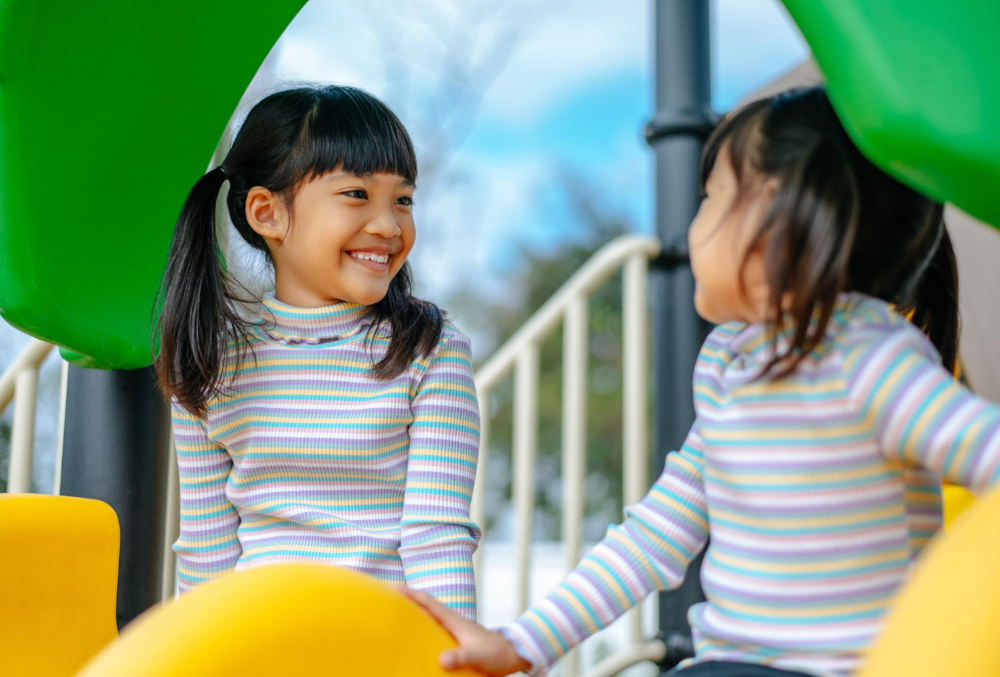
In Singapore's multicultural society, bilingualism runs deeper than academic requirements. It’s how a child belongs, how they stay connected to their heritage, and how they learn to move through a diverse world with genuine ease. The preschool years represent a narrow, remarkable window in which this capacity develops most naturally, and at Little Footprints Preschool, we’re intentional about making the most of it.
The Cognitive Superpowers of Bilingual Learners
Between the ages of three and six, neural pathways are forming at a pace that’ll never quite be replicated, and the auditory system is exquisitely sensitive to the sounds, tones, and rhythms of language. Children at this stage don’t study a language so much as absorb it, and that distinction matters enormously.
Guided by insights from Babilou Family's Scientific Education Committee, here’s what research tells us about its advantages and what bilingualism quietly builds in a young child's mind:
- Enhanced Executive Function: Managing two languages simultaneously trains the brain to switch between systems, filter distractions, and sustain focus. These are skills that transfer directly to self-regulation and learning readiness.
- Greater Cognitive Flexibility: Bilingual children are practised at holding more than one perspective in mind at once, making them more adaptable thinkers when faced with new or complex problems.
- Stronger Working Memory: The mental effort of navigating two languages strengthens the brain's capacity to hold, process, and apply information, a foundation for literacy and numeracy alike.
- Heightened Metalinguistic Awareness: Because bilingual children can observe and compare how two languages work, they develop a sharper, more intuitive understanding of grammar, meaning, and communication itself.
Mandarin, in particular, rewards early exposure in ways that are difficult to replicate later. Its tonal system and character-based script require a specific kind of phonetic awareness, an "ear" for the language, that develops most naturally through being immersed in it, not instruction. Children who grow up hearing, speaking, and engaging with Mandarin from a young age arrive at Primary 1 Mother Tongue lessons not with anxiety, but with familiarity.
What Does a Bilingual Learning Environment Look Like?
Language learned in isolation rarely sticks. The vocabulary memorised for a test, the phrase drilled in a workbook; these fade precisely because they were never connected to anything real. Genuine language acquisition happens when a child needs to use words to get something done, to express something felt, to understand something happening in front of them.
At Little Footprints Preschool, both English and Mandarin are mediums through which the entire day unfolds in each and every one of our childcare centres in Singapore.
- Daily Routines: From the morning greeting at the door to transitions between activities and the quiet rhythms of mealtime, our educators weave both languages into everyday moments. A child learns to say good morning, describe what they’re eating, and ask for help in both languages naturally.
- Creative Expression: Songs, storytelling, and dramatic play are among the richest contexts for language development. Children sing in Mandarin, act out stories in English, and narrate imaginative worlds in whichever language feels most alive to them in that moment.
- Hands-On Discovery: During nature walks, sensory exploration, or simple science experiments, children are encouraged to describe what they observe, predict what might happen, and share what they notice, drawing on both languages to make sense of the world around them.
For families seeking an even deeper immersion experience, Little Footprints is currently piloting a Chinese Immersion Programme at selected centres, available for children from Playgroup to Nursery levels. In this environment, Mandarin becomes the primary lens through which children explore, question, and understand their surroundings. Rather than treating Mandarin as a subject to be taught, the programme allows children to construct meaning through the language itself, building confidence, fluency, and a genuine sense of ownership over both their linguistic identity and their learning.
The Parents’ Playbook: How to Raise a Bilingual Kid at Home
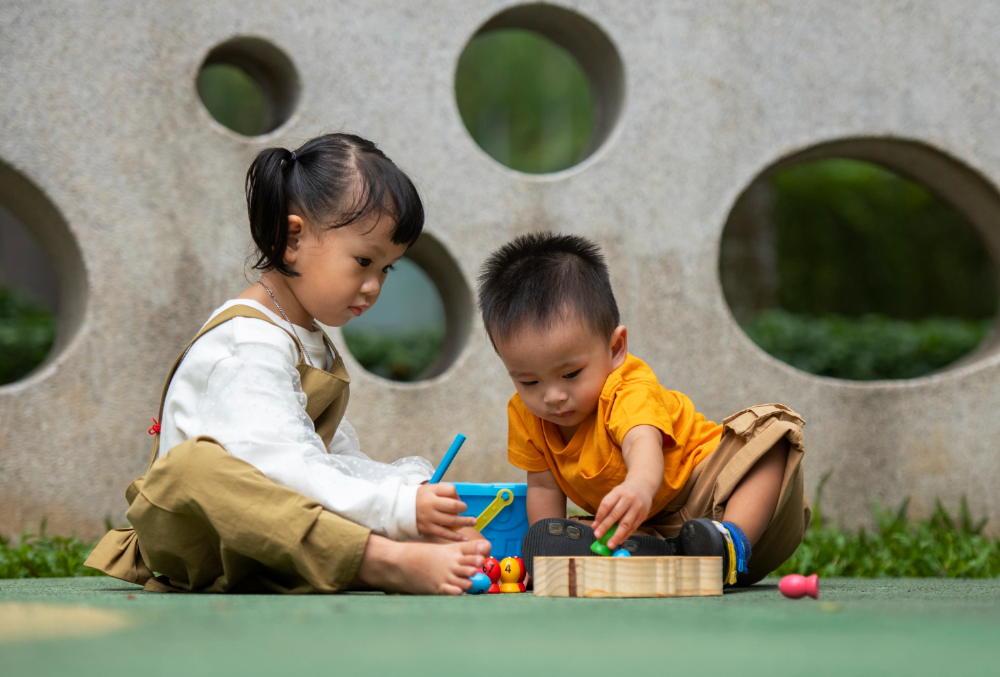
The environment of a preschool in Singapore lays a strong foundation, but language truly flourishes when it’s alive at home too. The good news is that supporting bilingual development doesn’t require flashcards, formal lessons, or fluency in both languages, but simply presence, warmth, and a willingness to make both languages feel like natural parts of daily life.
Start by letting go of the idea that language learning needs to be structured. Some of the richest language moments happen over dinner, during bath time, or on the way to school; low-stakes, high-interest conversations where a child is relaxed enough to experiment. Ask questions in Mandarin, narrate what you’re doing and laugh at mispronunciations together.
Beyond conversation, a print-rich home makes a quiet but meaningful difference. Bilingual picture books, Chinese storybooks, and even simple household labels in both scripts signal to a child that both languages have a place here. When stories are read in Mandarin with the same warmth and enthusiasm as those in English, children pick up on this attitude.
The wider community is a resource too. A visit to a local wet market, a meal at a hawker centre, a conversation with a grandparent. These are immersive, memorable contexts where Mandarin is spoken naturally and purposefully. Children notice that the language works in the real world, and that noticing matters.
Finally, and perhaps most importantly, parents don’t need to be linguists. What children need most is to see that the adults they trust value both languages with equal warmth. A positive, unhurried attitude toward Mandarin, even from a parent who’s still learning, creates the psychological safety a child needs to take risks, make mistakes, and grow.
How a Bilingual Preschool Supports Your Child's Linguistic Journey
The environment a child spends their days in shapes not just what they learn, but how they feel about learning. At Little Footprints Preschool, our centres are designed to make both English and Mandarin feel equally present, equally celebrated, and equally real. Bilingual signage, library corners stocked with stories in both languages, and educators who move fluidly between the two; all of this tells a child, quietly and consistently, that both belong.
We also understand that the path to bilingualism isn’t always linear. There’ll be days when a child reaches for English when they mean to speak Mandarin, or falls quiet when they’re still working something out. In our experiential learning model, every attempt at communication is welcomed. We celebrate the trying, not just the getting-it-right, because that celebration is what builds the confidence and resilience a child will need as they move through bilingual education and into primary school.
Curious about how our bilingual environment sparks your child's curiosity? We invite you to see it for yourself. Book a school tour at a centre near you today.


