
Most parents have seen it: a child pushing a puzzle away in frustration, declaring, "I can't do it." The instinct is to reassure or step in. But that moment is a window into how a child understands effort and ability, and that understanding can be changed.
The beliefs children hold about their own capabilities shape everything. How they approach a difficult worksheet, how they handle a friendship falling apart, whether they push through or walk away when things feel hard. Getting the child's mindset right in these early years matters more than most parents realise.
What is Growth Mindset?
Psychologist Dr Carol Dweck's research introduced a concept that has reshaped thinking in education: the idea that abilities aren't fixed at birth but can be developed through effort, practice and learning from mistakes. Growth mindset examples are all around: a child who tries a puzzle again after getting it wrong, or who asks, "Can we do it differently?" instead of giving up. Its counterpart, the fixed mindset, is the belief that you're either good at something or you're not.
For children approaching Primary 1, this distinction matters. The step-up in expectations, structure and social complexity is real. Children with a growth mindset are better equipped to handle it. They're less likely to shut down when something feels hard, and more likely to recover from setbacks in group work or friendships.
Growth mindset isn't the same as toxic positivity. Difficulty, approached well, is one of the most useful experiences a child can have.
How to Develop a Growth Mindset in Your Child
Praise the process, not the outcome. Shifting from "You're so clever" to "I noticed how hard you kept trying" changes what a child learns from the moment. One praises a fixed trait; the other reinforces that effort is what drives progress.
Normalise 'not yet'. A simple addition to any statement of limitation: those two words. "I can't do this" becomes "I can't do this yet." It reframes the sentence from a verdict into a work in progress, which is exactly how learning works.
Model your own mistakes openly. Children learn as much from watching you as from being taught directly. Let them see you get something wrong, try again, and respond calmly. Your reaction to setbacks is one of the most instructive things they'll observe.
Reframe challenge as the point. When a child finds something hard, resist the urge to simplify it immediately. Acknowledge it plainly: "Yes, this is tricky. That means your brain is working." The message is that difficulty is a sign of progress, not a reason to stop.
Celebrate effort at home. Simple rituals help. A "brave try" acknowledgement at dinner gives children a regular moment to reflect on persistence rather than just results.
These habits are easier to build alongside the right stories. Growth mindset books worth reading together include The Dot and Ish by Peter H. Reynolds, Beautiful Oops! by Barney Saltzberg, Your Fantastic Elastic Brain by JoAnn Deak, and What Do You Do With a Problem? by Kobi Yamada.
How Little Footprints Preschool Nurtures a Positive Growth Mindset
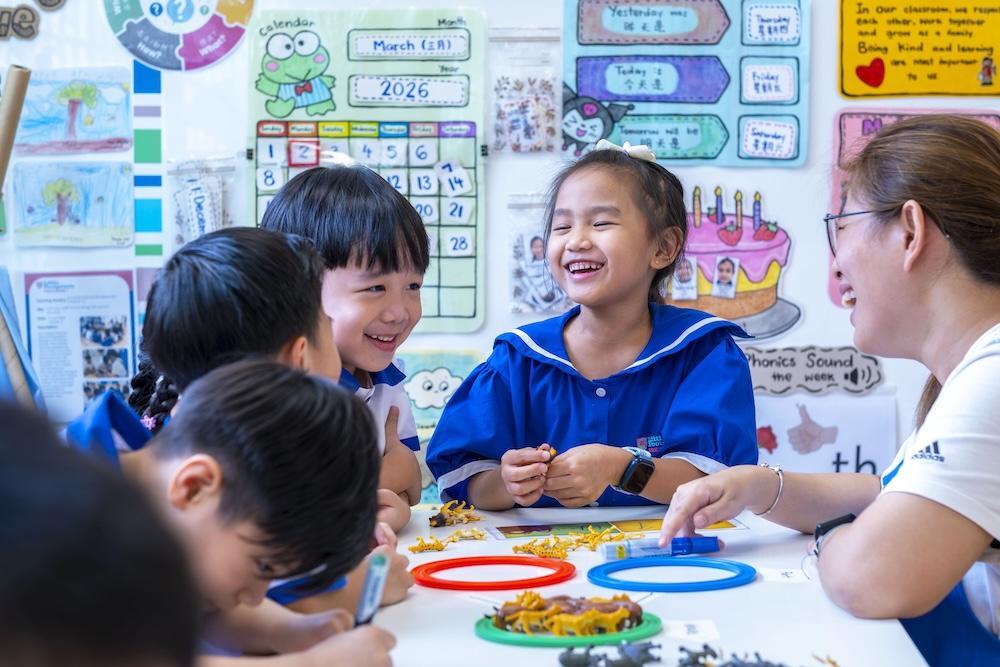
At Little Footprints, a childcare centre in Singapore built around the Sustainable Education® approach, educators respond to struggle with curiosity rather than rescue. When a child gets stuck, they ask "What could we try next?" rather than providing the answer. This is the 'I Can' culture woven through our classrooms.
Our partnership with the Singapore Kindness Movement takes character development beyond the classroom, building the social resilience and emotional awareness that a growth mindset depends on. Open-ended questions during activities prompt children to reflect rather than simply recall.
For families weighing preschool fees in Singapore, Little Footprints keeps quality early education affordable across our heartland centres.
A child who believes they can grow approaches Primary 1 with a willingness to try, and that willingness is something we build together, one moment at a time.
Curious to see our approach in action? Book a centre tour or join us at an upcoming Open House. We would love to meet your family.


